
Case Study — ForeCash
ForeCash: Helps users forecast savings, plan finances, and track transactions with AI insights.
Strengthen financial clarity for individuals and businesses by transforming complex cash flow data into actionable insights. Furthermore, streamline forecasting and money management to help users make confident financial decisions without spreadsheets or guesswork.

Role
Product Designer
Project Type
Self Concept
Duration
4 Months
Industry
FinTech/AI Wealth Management
Background Information
This project started as a self-initiated exploration.
I noticed that most finance apps either:
Focus heavily on charts and numbers
Surface problems without guidance
Assume high financial literacy
As someone interested in human-centered systems, I wanted to explore:
How might we help people feel more in control of their money without overwhelming them?
Jesse
Caitlyn
Problem Statement
Traditional budgeting tools often focus on tracking spending but fail to guide users with purpose or help them stay motivated.
People know what they earn and what they spend, but they struggle with saving intentionally or working toward meaningful milestones like starting a business, paying off student debt, or travelling the world.
Project goals
To increase user engagement and retention
Reduce drop-offs during onboarding
Raise goal completion rates
Strengthen organic growth via clear value communication in web + app plaatforms.
Prioritizing the problem
I focused on the highest-friction moment in the journey (i.e)
Interpreting forecasts and acting on them. This was validated through the following factors.
User Interviews
Session Recordings
Funnel drop-off analysis
Trade-offs
Reduced Visual density to improve clarity (at the cost of showing less data upfront)
Prioritized progressive disclosure over power-user shortcuts
Accessibility & Scale
Clear contrast ratios
Readable typography for long data sessions
Components designed to scale across future forecast types.
Affinity Mapping
The affinity mapping exercise organized diverse user insights into clear themes, revealing key financial needs, behaviors, and decision making triggers.
These insights shaped ForeCash’s Customer Journey Map, ensuring each stage addresses real and validated user needs.

Research & Insights
Field & Behavioral Discovery
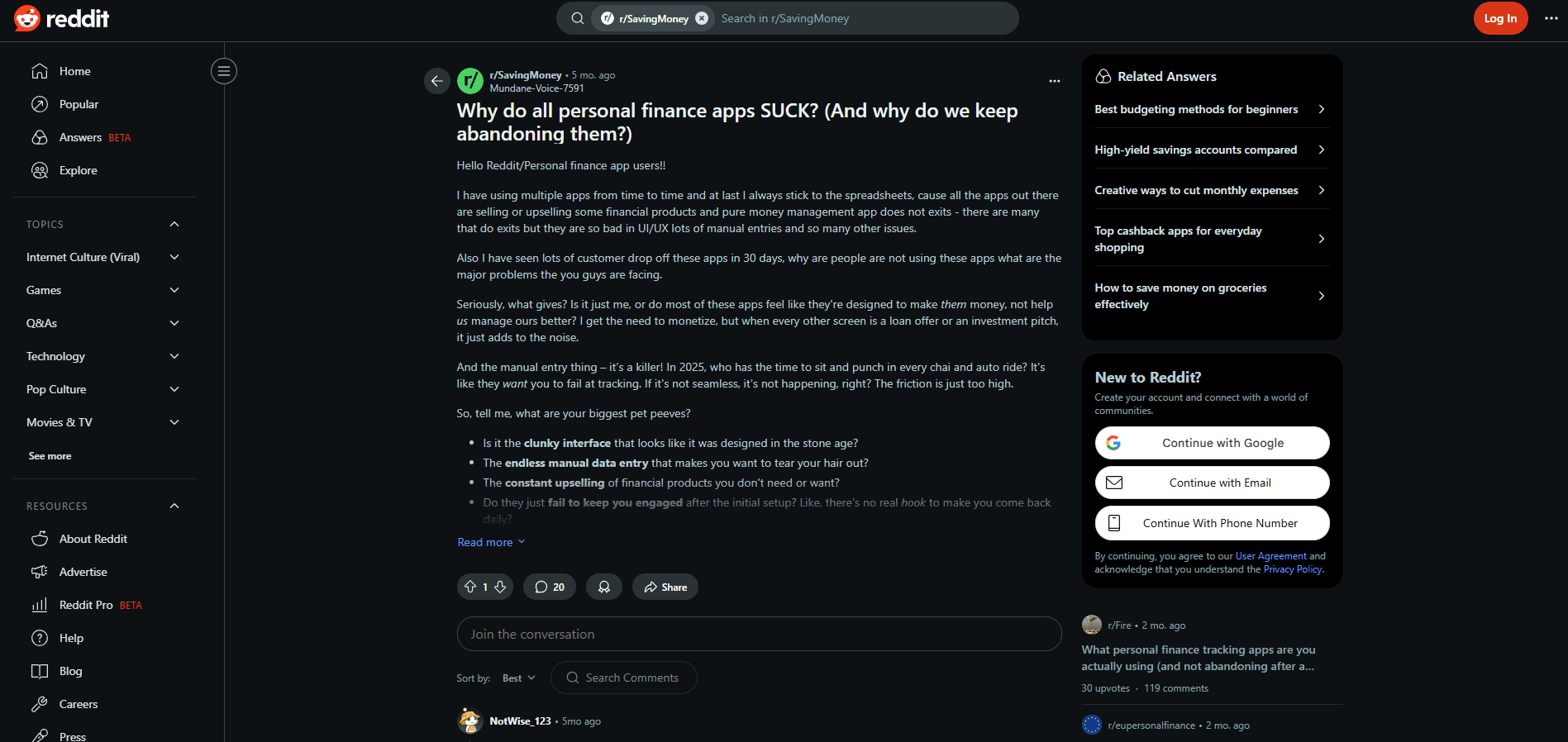
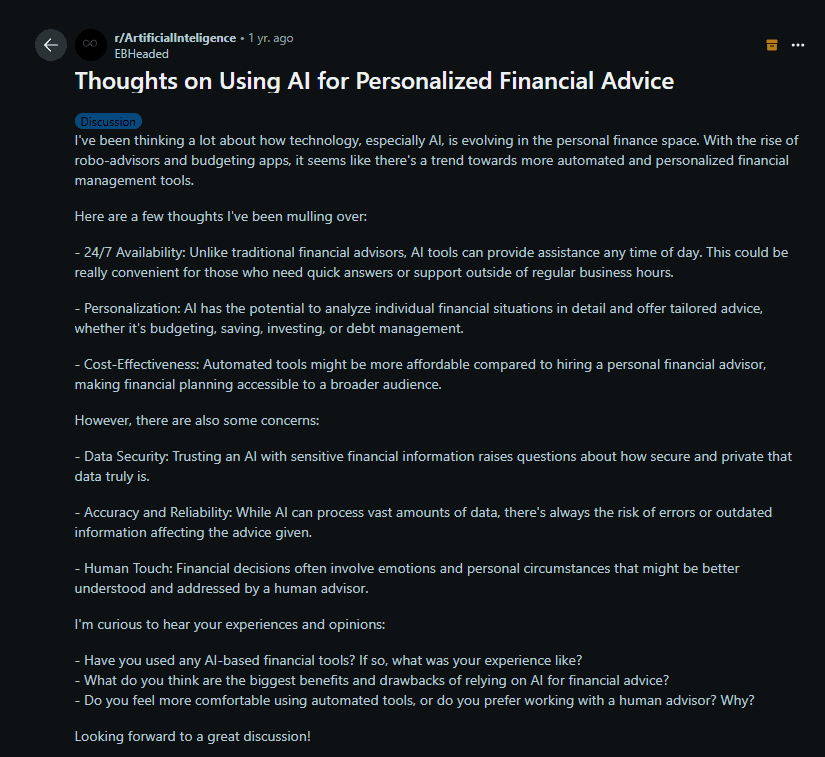
I analyzed financial discussions across communities where people expressed frustration with existing financial tools that focus only on tracking historical spending without helping them anticipate or plan ahead.
Key Insights
Users want a partner-like financial experience, not a ledger -
something that tells them “Here’s what’s likely to happen with your money” and “Here’s how to reach your goal with simple steps.”

Usability Tests
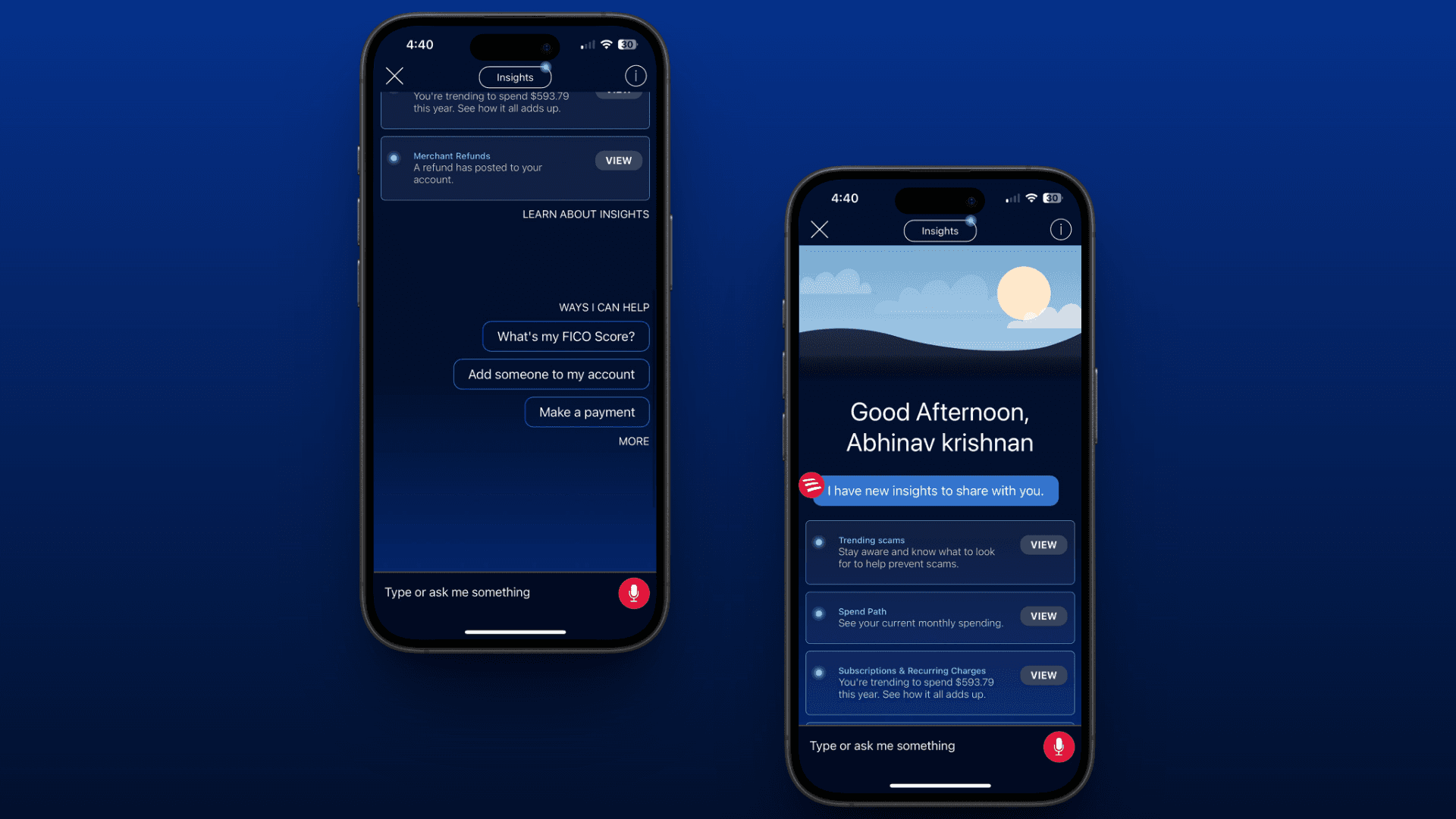
I conducted usability tests with target users to validate design decisions and identify areas for improvement. The test consisted of an interview and completing specific task on an AI chat box in banking and financial wellness apps.

Usability Test #1- Erica AI (Bank Of America)
"I tried asking the AI about my financial goals in my own words,
but it only offered a few preset questions to choose from.
When I typed anything outside those options, it could not give me an answer."
Usability testing showed that limiting user input to predefined selections reduces the usefulness of an AI assistant. Financial needs are often unique, and users expect the freedom to phrase questions naturally. When the system fails to respond to anything beyond its scope, it creates frustration and prevents deeper engagement with the tool.
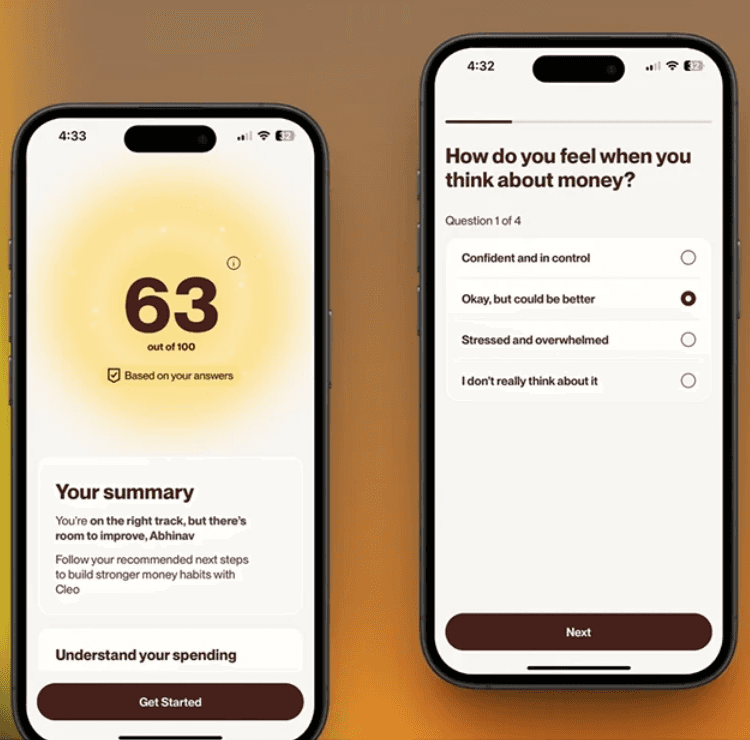
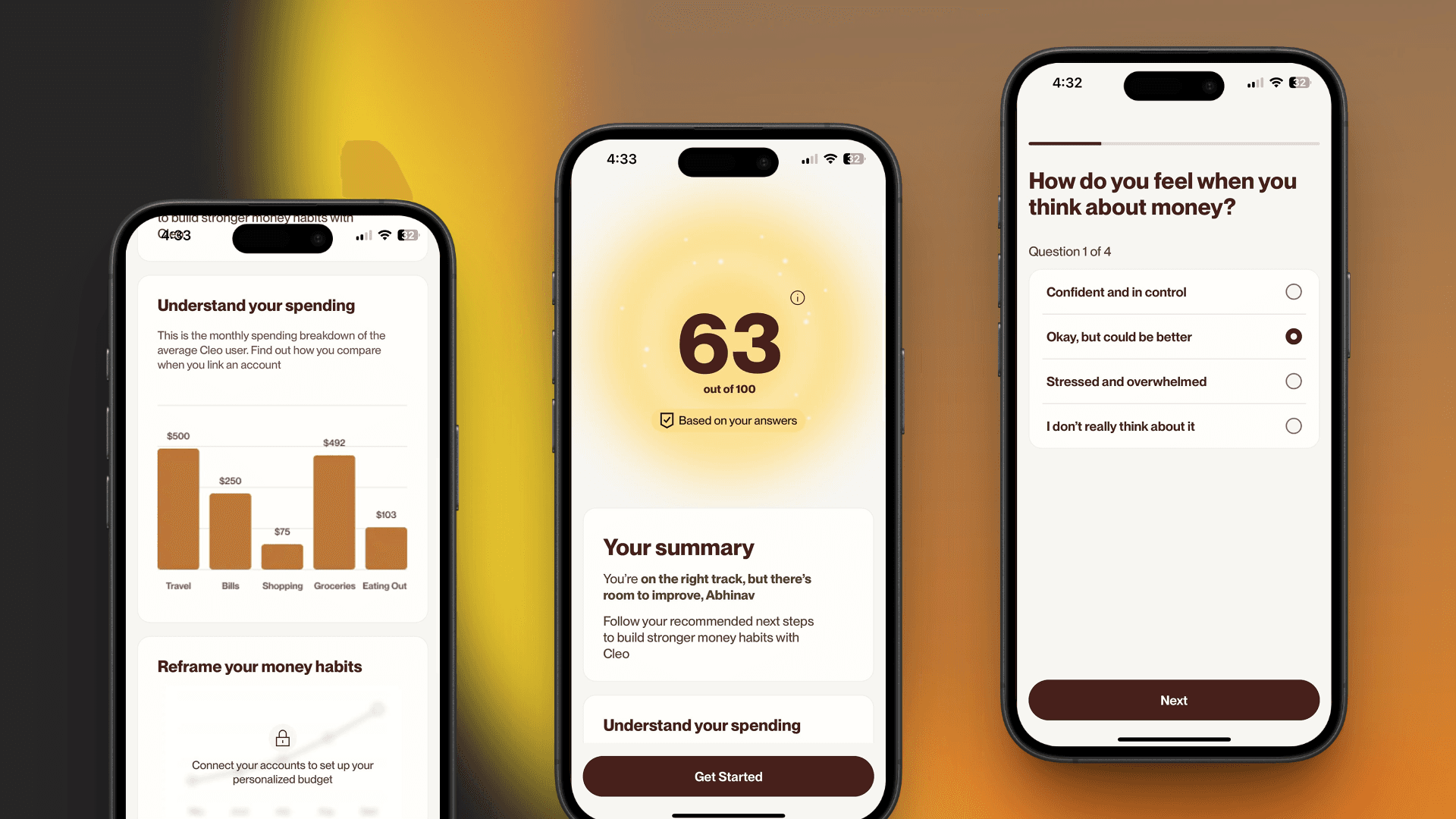
"Usability Test #2- Cleo AI"
"The AI responds in a friendly and engaging way, but it cannot give me a personalized forecast or plan based on my specific situation.
It feels like I am getting generic advice instead of something tailored to me."
Testing revealed that while personality and engagement are strengths, the absence of personalized forecasting leaves a significant gap for users who want actionable, data-driven insights. Financial wellness tools must go beyond general tips and provide tailored strategies that help users reach their individual goals.
Requirements
Based on the discoveries obtained, I started formulating the contents as to what the users really want to see in this website/app. These things came to my mind:
An interactive AI to ask for financial advices
Clear visual of their finances
Set specific targets they want to achieve using the AI chat
Keep track of their progress of a specific target/goal
Adjust their plan according to circumstances
Show clear data of the user’s transaction history
Show how much they owe and how much they are owed from people
Keep the chat minimalistic and to the point content/forecasting
Clear and easy to navigate onboarding experience

User Segments Identified
Primary Audience:
Young professionals (22–35) juggling irregular income
People who don’t want strict budgets but want clarity and control
Goal-oriented individuals saving for milestones (debt repayment, travel, business, investments)
User Needs:
Quick understanding of future cash flow
Simple visuals that don’t require financial expertise
Personalized advice and next-step suggestions
User Persona
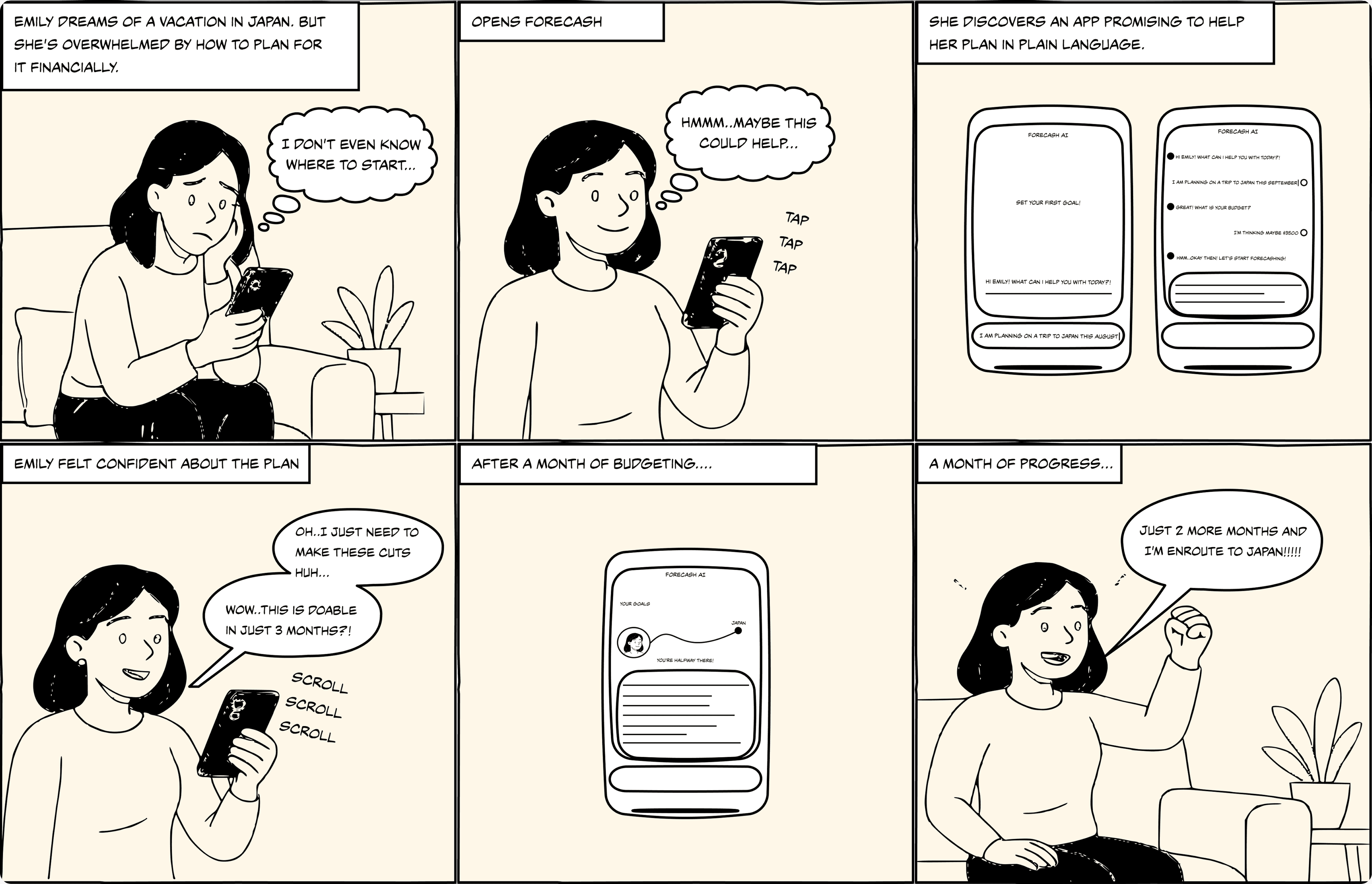
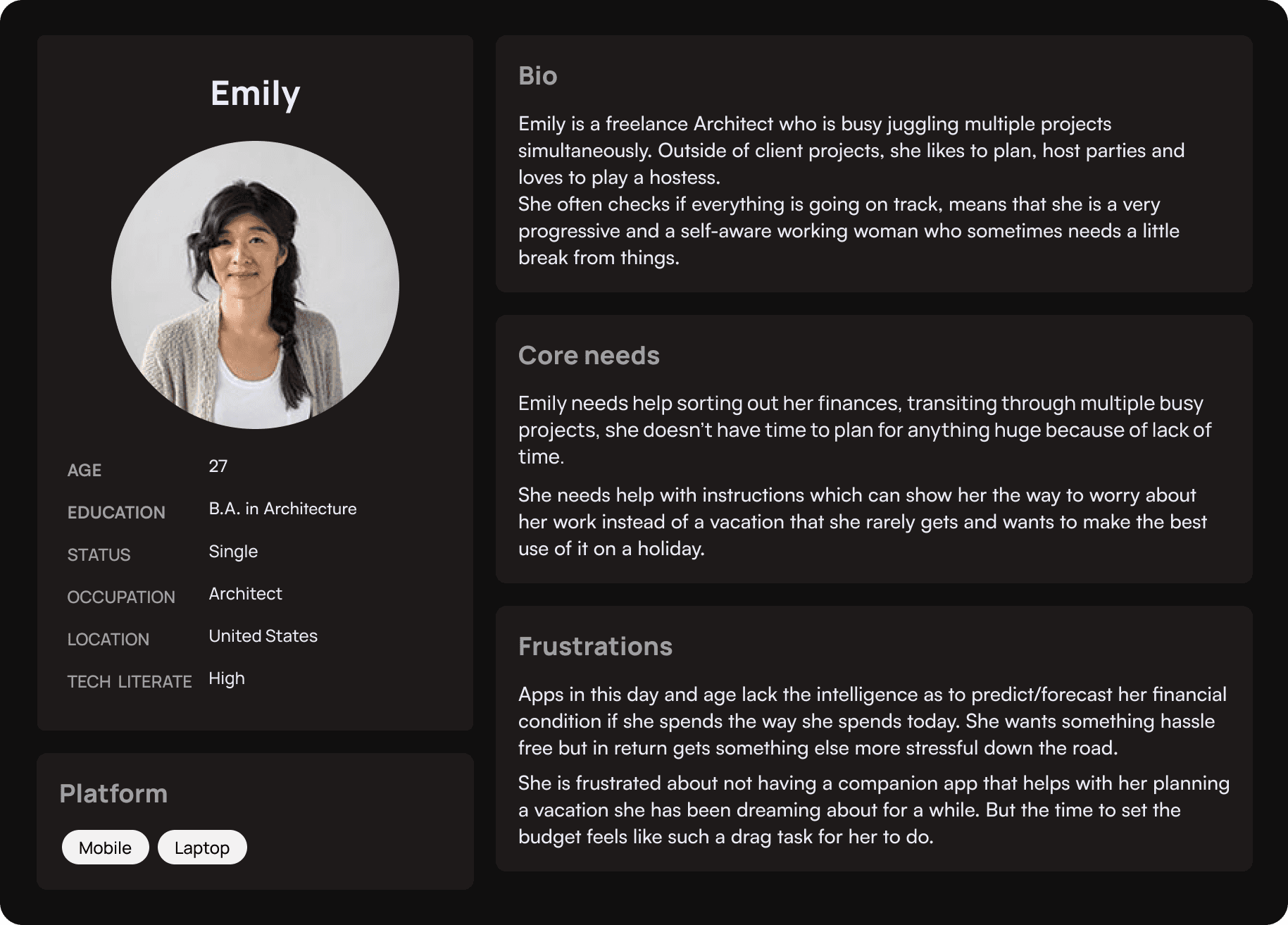
I created Emily based on usability tests and affinity mapping, representing busy young professionals who lack time for financial planning. She reflects frustrations with generic apps and the need for a simple, personalized tool to set and track goals.
Solutions
The feedback from usability testing shaped the final iteration of ForeCash into a platform that not only forecasts savings but actively motivates users to achieve their biggest financial goals.
Core Design Decisions
Progressive Disclosure: Users see summaries first, details on demand
Scenario Comparison: Side-by-side layouts reduce memory load
Explainability: AI-generated insights explain why a forecast changes.
Why these decisions matter:
Instead of overwhelming users with raw numbers, the design guides them toward actionable understanding.
I focused more on flows, assumptions, and reasoning than visual polish, mirroring real-world product problem solving.
AI-Driven Insights to Empower the User's Finances
Boost clarity, eases decision making process & most importantly gives the sense of trust.
AI-Powered Insights
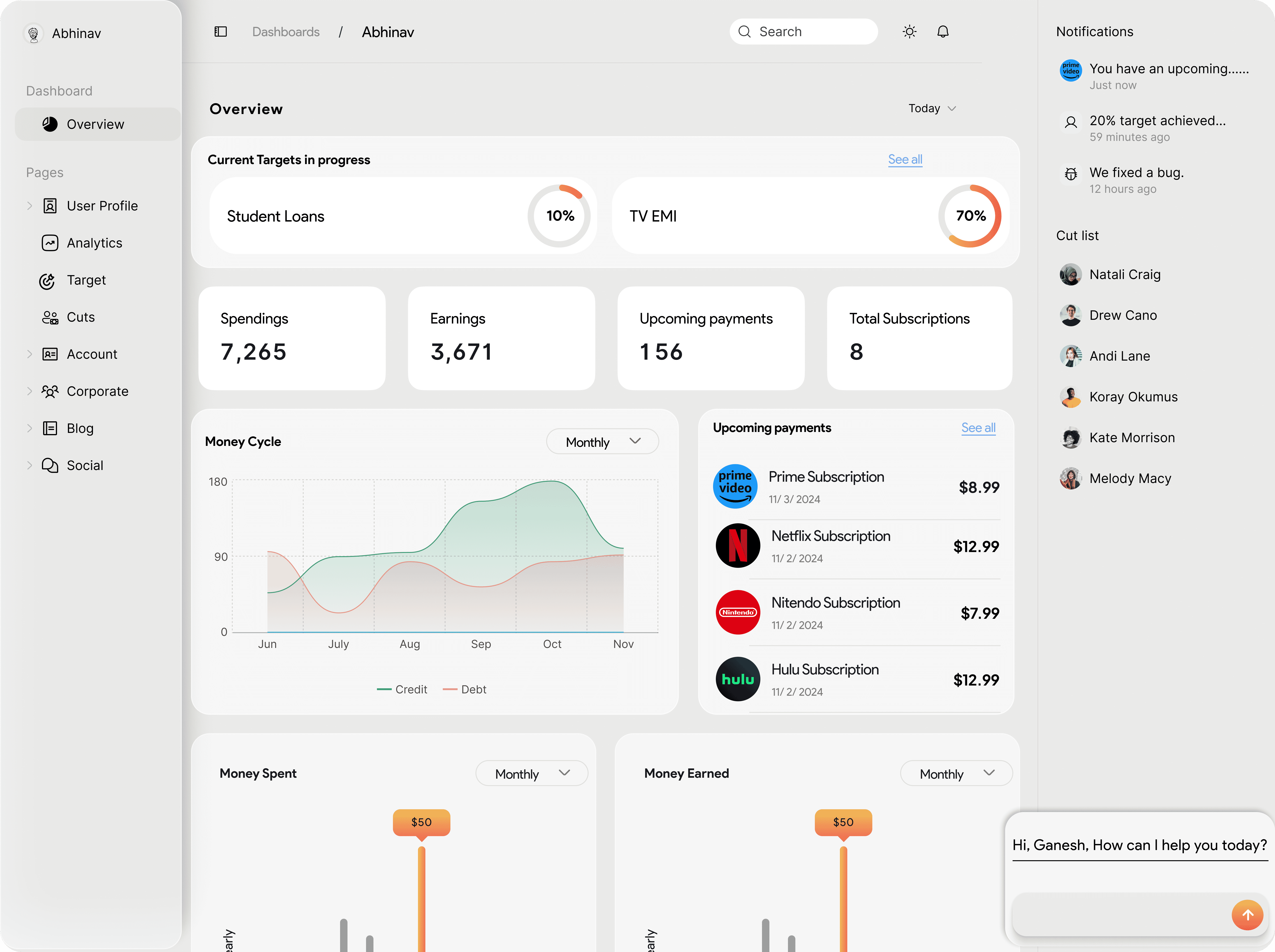
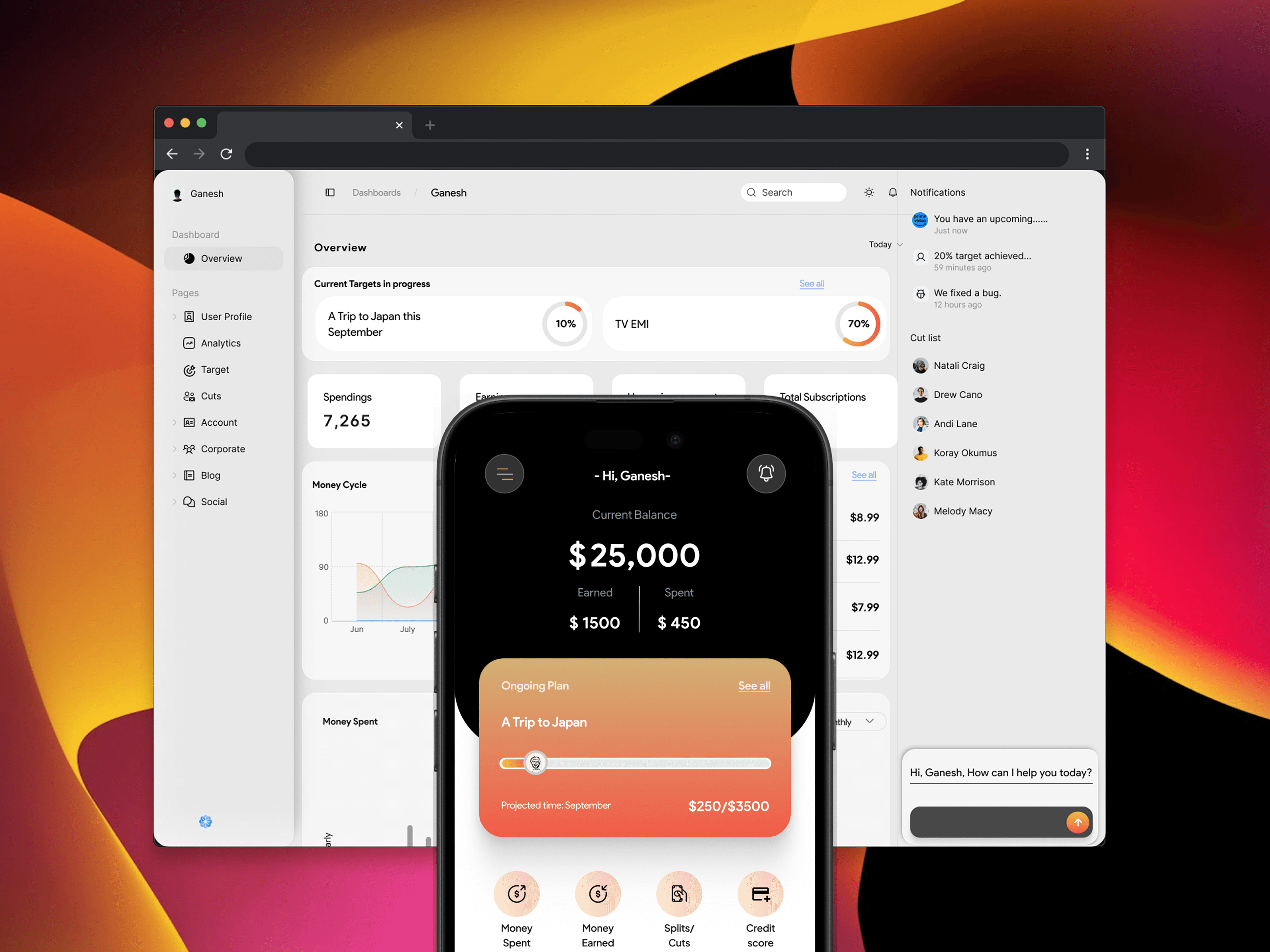
AI-Centered Experience chat that helps users create and adjust financial plans, while a dashboard tracks goals, transactions, payments, and shared expenses.

AI-Powered Insights
Insights stay consistent across web and mobile, creating a seamless experience whether users plan purchases at home or check budgets on the go.
AI-Powered Insights
ForeCash evolved from a simple tracker into an adaptive partner, helping users set savings goals, link them to spending habits, and track progress with personalized insights.

Design System
I created the ForeCash design system to ensure clarity and consistency across the platform. I chose a warm, professional color palette with clear feedback states, a clean sans-serif type for readability, and rounded components with subtle shadows for a modern feel.
Simple icons, customizable avatars, and a streamlined navigation bar make the experience approachable, while progress indicators keep users motivated.

Onboarding
I designed two versions of onboarding.
Authentic version :
Clean, minimal screens focused on clarity and functionality, guiding the user with simple messaging and clear login/permission steps.
Illustrated version :
Flashy visuals with playful illustrations and subtle motion design, creating a more engaging and expressive experience.

Authentication & Dashboard
The login, registration, and OTP flows are simple and secure, leading into a motivating success screen. The dashboard gives users a clear overview of their balance, subscriptions, and recent transactions.

Goals & Transactions
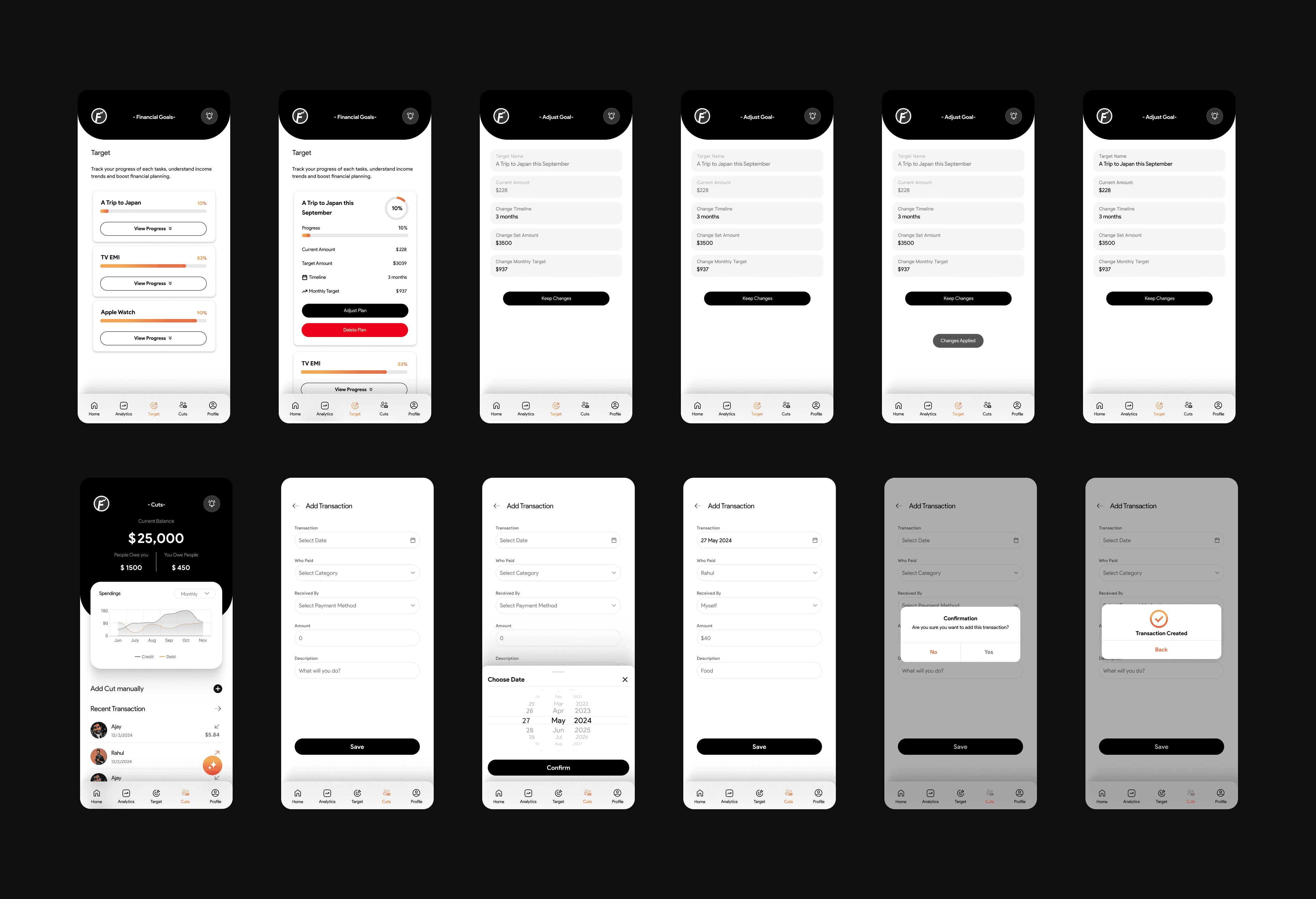
Users can set financial goals with progress tracking and edit them anytime. Adding transactions is intuitive with categories, payment methods, and confirmation to avoid mistakes.
Profile, Security & Analytics
Profile settings cover personalization, security, and document storage. Analytics provide insights into spending patterns and link them back to personal savings goals with visual clarity.

AI Interaction
This AI interaction video demonstrates how conversational assistance guides users with smart suggestions, reminders, and financial nudges, blending automation with a human-like experience.

Conclusion
The feedback from usability testing shaped the final iteration of ForeCash into a platform that not only forecasts savings but actively motivates users to achieve their biggest financial goals.

Latest Project


CONTACT

Reach out to start a conversation, share a vision, or create something impactful.
CONTACT
Reach out to start a conversation, share a vision, or create something impactful.
Case Study — ForeCash
ForeCash: Helps users forecast savings, plan finances, and track transactions with AI insights.
Strengthen financial clarity for individuals and businesses by transforming complex cash flow data into actionable insights. Furthermore, streamline forecasting and money management to help users make confident financial decisions without spreadsheets or guesswork.
Role
Product Designer
Project Type
Self Concept
Duration
4 Months
Industry
FinTech/AI Wealth Management
Year
2025
Role
Product Designer
Project Type
AI Wealth Management
Duration
4 Months
Background Information
This project started as a self-initiated exploration.I noticed that most finance apps either:
Focus heavily on charts and numbers
Surface problems without guidance
Assume high financial literacy
As someone interested in human-centered systems, I wanted to explore:
| How might we help people feel more in control of their money without overwhelming them?
Jesse
Caitlyn
Problem Statement
Traditional budgeting tools often focus on tracking spending but fail to guide users with purpose or help them stay motivated.
People know what they earn and what they spend, but they struggle with saving intentionally or working toward meaningful milestones like starting a business, paying off student debt, or travelling the world.

Project goals
To increase user engagement and retention
Reduce drop-offs during onboarding
Raise goal completion rates
Strengthen organic growth via clear value communication in web + app plaatforms.
Prioritizing the problem
I focused on the highest-friction moment in the journey (i.e)Interpreting forecasts and acting on them. This was validated through the following factors.
User Interviews
Session Recordings
Funnel drop-off analysis
Trade-offs:
Reduced Visual density to improve clarity (at the cost of showing less data upfront)
Prioritized progressive disclosure over power-user shortcuts
Accessibility & Scale:
Clear contrast ratios
Readable typography for long data sessions
Components designed to scale across future forecast types.
Affinity Mapping
The affinity mapping exercise organized diverse user insights into clear themes, revealing key financial needs, behaviors, and decision making triggers.
These insights shaped ForeCash’s Customer Journey Map, ensuring each stage addresses real and validated user needs.
Research & Insights
Field & Behavioral Discovery
I analyzed financial discussions across communities where people expressed frustration with existing financial tools that focus only on tracking historical spending without helping them anticipate or plan ahead.
Key Insights
Users want a partner-like financial experience, not a ledger -something that tells them “Here’s what’s likely to happen with your money” and “Here’s how to reach your goal with simple steps.”

Usability Tests
I conducted usability tests with target users to validate design decisions and identify areas for improvement. The test consisted of an interview and completing specific task on an AI chat box in banking and financial wellness apps.
Usability Test #1- Erica AI (Bank Of America)
"I tried asking the AI about my financial goals in my own words,but it only offered a few preset questions to choose from.When I typed anything outside those options, it could not give me an answer."
Usability testing showed that limiting user input to predefined selections reduces the usefulness of an AI assistant. Financial needs are often unique, and users expect the freedom to phrase questions naturally. When the system fails to respond to anything beyond its scope, it creates frustration and prevents deeper engagement with the tool.
"Usability Test #2- Cleo AI"
"The AI responds in a friendly and engaging way, but it cannot give me a personalized forecast or plan based on my specific situation.It feels like I am getting generic advice instead of something tailored to me."
Testing revealed that while personality and engagement are strengths, the absence of personalized forecasting leaves a significant gap for users who want actionable, data-driven insights. Financial wellness tools must go beyond general tips and provide tailored strategies that help users reach their individual goals.
Requirements
Based on the discoveries obtained, I started formulating the contents as to what the users really want to see in this website/app. These things came to my mind:
An interactive AI to ask for financial advicesClear visual of their finances
Set specific targets they want to achieve using the AI chatKeep track of their progress of a specific target/goal
Adjust their plan according to circumstances
Show clear data of the user’s transaction history
Show how much they owe and how much they are owed from people
Keep the chat minimalistic and to the point content/forecastingClear and easy to navigate onboarding experience
User Segments Identified
Primary Audience:
Young professionals (22–35) juggling irregular income
People who don’t want strict budgets but want clarity and control
Goal-oriented individuals saving for milestones (debt repayment, travel, business, investments)
User Needs:
Quick understanding of future cash flow
Simple visuals that don’t require financial expertise
Personalized advice and next-step suggestions
User Persona
I created Emily based on usability tests and affinity mapping, representing busy young professionals who lack time for financial planning. She reflects frustrations with generic apps and the need for a simple, personalized tool to set and track goals.
Solutions
The feedback from usability testing shaped the final iteration of ForeCash into a platform that not only forecasts savings but actively motivates users to achieve their biggest financial goals.
Core Design Decisions:
Progressive Disclosure:
Users see summaries first, details on demand
Scenario Comparison: Side-by-side layouts reduce memory load
Explainability: AI-generated insights explain why a forecast changes.
Why these decisions matter:
Instead of overwhelming users with raw numbers, the design guides them toward actionable understanding.
I focused more on flows, assumptions, and reasoning than visual polish, mirroring real-world product problem solving.
Design | Onboarding
I designed two versions of onboarding.
Authentic version:
Clean, minimal screens focused on clarity and functionality, guiding the user with simple messaging and clear login/permission steps.
Illustrated version:
Flashy visuals with playful illustrations and subtle motion design, creating a more engaging and expressive experience.
Design | Authentication & Dashboard
The login, registration, and OTP flows are simple and secure, leading into a motivating success screen. The dashboard gives users a clear overview of their balance, subscriptions, and recent transactions.
Design | Goals & Transactions
Users can set financial goals with progress tracking and edit them anytime. Adding transactions is intuitive with categories, payment methods, and confirmation to avoid mistakes.
Design | Profile, Security & Analytics
Profile settings cover personalization, security, and document storage. Analytics provide insights into spending patterns and link them back to personal savings goals with visual clarity.
Conclusion
The feedback from usability testing shaped the final iteration of ForeCash into a platform that not only forecasts savings but actively motivates users to achieve their biggest financial goals.
AI-Driven Insights to Empower the User's Finances
Boost clarity, eases decision making process & most importantly gives the sense of trust.
AI-Powered Insights
AI-Centered Experience chat that helps users create and adjust financial plans, while a dashboard tracks goals, transactions, payments, and shared expenses.
AI-Powered Insights
AI-Centered Experience chat that helps users create and adjust financial plans, while a dashboard tracks goals, transactions, payments, and shared expenses.
AI-Powered Insights
Insights stay consistent across web and mobile, creating a seamless experience whether users plan purchases at home or check budgets on the go.
AI-Powered Insights
ForeCash evolved from a simple tracker into an adaptive partner, helping users set savings goals, link them to spending habits, and track progress with personalized insights.
AI-Powered Insights
ForeCash evolved from a simple tracker into an adaptive partner, helping users set savings goals, link them to spending habits, and track progress with personalized insights.
Latest Project
CONTACT
Reach out to start a conversation, share a vision, or create something impactful.